
A housing association board governs AI well when it has decided three things: what AI may do on its own, what must always come back to a person, and how the board will know that line is holding. Most boards haven't yet made those decisions explicitly, even though AI is already at work inside their organisations.
This guide is for chairs, board members, company secretaries and directors of governance at registered providers. It covers why AI is already a board matter, what the regulatory framework expects, the questions to ask before approving an AI system, and how to move from an AI policy to a governance design that will last. It also points to the AOS Specifications: an open, freely downloadable set of documents that set out that design in full.
I'm Mark Sweeny. I've worked in social housing for over 40 years: in local authority housing, as head of IT at a housing group, leading governance consultancy at Tribal and Altair, and since 2020 advising boards through 21CHG, including as an interim Director of Governance and Company Secretary. I've chaired two housing associations and served on several boards and audit committees. I also wrote the Holding the Line series on governance in the age of AI.
AI is already a board issue
Ask most housing boards whether they have approved the use of AI, and the honest answer is "not really". Ask whether AI is being used in the organisation, and the honest answer is almost always "yes".
It arrives in ordinary ways:
- Repairs and maintenance: scheduling, triage of incoming reports, and predicting which components will fail next.
- Damp and mould: sensor data and models that flag homes at risk before a resident reports a problem.
- Income: arrears risk scoring that decides who gets an early call.
- Resident contact: chatbots and automated email triage.
- Everyday work: staff using general-purpose tools such as ChatGPT or Copilot to draft letters, summarise case notes or write reports, often on their own initiative.
Very little of this came through the board. It arrived through operations, procurement or IT, usually as a feature of software the organisation already used. That is the governance gap. The board remains accountable for decisions that are increasingly shaped by systems it never considered.
None of this means AI is a problem to be contained. Used well, it lets a housing organisation understand its homes, its residents and its own performance far better than before. But "used well" is a governance question, not a technical one.
What regulators and the sector expect
There is no single AI regulation for housing. The expectations come from frameworks boards already work within, which is precisely why AI belongs on the board agenda rather than in an IT policy.
The Regulator of Social Housing's position on AI. In October 2026 the regulator set out its approach. It has not announced separate AI rules. Its framework is outcomes-based, so AI is judged by whether landlords still deliver the outcomes in the existing standards. It expects a robust framework and oversight before significant adoption of AI, says human judgement remains essential for decisions affecting people's homes and lives, and asks landlords to manage risks around data quality, data protection, bias and cyber security. As it puts it: "Ultimately, responsibility for the effective and appropriate use of AI rests with the landlord."
The Governance and Financial Viability Standard. The standard requires governance arrangements that ensure a provider adheres to all relevant law and has an effective risk management and internal controls assurance framework, with systems that accurately report delivery of its plans. Boards certify compliance every year. An AI system shaping operational decisions falls squarely within that framework.
The consumer standards. Since 1 April 2024, the consumer standards have been proactively regulated. Two are directly relevant:
- The Safety and Quality Standard requires landlords to have "an accurate, up to date and evidenced understanding of the condition of their homes". AI increasingly produces that understanding, so its reliability becomes a compliance question.
- The Transparency, Influence and Accountability Standard requires landlords to treat tenants with fairness and respect, deliver fair and equitable outcomes, and give tenants the information they need to hold their landlord to account. If an AI system influences how a resident is treated, the landlord needs to be able to explain it.
Awaab's Law. Since 27 October 2025, social landlords in England have had fixed legal timescales to investigate and fix emergency hazards and significant damp and mould. A second phase, extending the timescales to more hazards, starts on 30 November 2026. (Government guidance) AI prediction tools can help landlords meet these duties, but a missed alert is still the landlord's failure, not the software's.
Data protection. The Data (Use and Access) Act 2025 changed the UK GDPR rules on automated decision-making from February 2026. Decisions with significant effects can now be made solely by automated means, but only with safeguards: people must be told, be able to make representations and contest the decision, and be able to obtain human intervention. Tighter limits remain where special category data, such as health information, is involved.
Equality. AI trained on historic data can reproduce historic unfairness. The Equality Act 2010 applies to landlords and service providers whether or not a decision was AI-assisted, so boards need assurance that AI doesn't disadvantage residents with protected characteristics.
The Housing Ombudsman. The Ombudsman's spotlight report on knowledge and information management (May 2023) found that poor information management is a common reason services fail residents, and made 21 recommendations. AI amplifies whatever data it is given.
The NHF AI Code of Practice. The National Housing Federation's AI Code of Practice is a voluntary code for housing associations. It covers governance, data protection and privacy, security and risk management, and ethical and environmental considerations, with practical tools including a board assurance checklist and supplier due-diligence questions. The questions and maturity stages in this guide are designed to sit alongside it.
The thread running through all of these is simple: the board cannot delegate accountability to a system. Compliance has to be built into how AI is designed and deployed, not checked afterwards. In the Governance Intelligence vocabulary this is called Compliant by Design, and it goes one step further: decisions are tested against the organisation's own purpose as well as the regulations, because an organisation can pass every regulatory test and still drift from what it was set up to do.
Governing AI versus governing with AI
On 18 June 2026, at the National Housing Federation's Housing Governance Conference, I joined a panel on understanding regulation through AI and its potential implications. The distinction that kept coming back was between governing AI and governing with AI.
Governing AI means oversight of the tools: an AI policy, a risk register entry, supplier due diligence, an approval route for new systems. It is necessary, and it is where most organisations stop.
Governing with AI means recognising that AI changes the board's own work. Information no longer has to arrive curated and weeks old at a quarterly meeting. A board can see repairs performance, resident sentiment, staff turnover and compliance as they change, rather than after problems have set in. I call this Perpetual Sensing. It changes the board's question from "did we comply?" to "are we still doing what we said we stood for, as the picture shifts?"
It also changes accountability. Residents, regulators and funders can increasingly question the reasoning behind decisions directly, rather than waiting for an explanation to be offered. That is Radical Transparency: the board's authority doesn't shrink, but it loses the option of claiming an understanding nobody else can check.
A board that only governs AI will always be catching up. A board that also governs with AI can see further ahead, but only if it has designed its governance for that from the start.
Ten questions to ask before approving an AI system
These questions work for any AI system, whether it is a new product, a feature switched on in existing software, or a tool staff want to use.
- What decision does this system influence, and who remains accountable for that decision?
- Could a resident be affected by its output without a person reviewing it first?
- What data does it use, and were residents told their data would be used this way?
- How will we know if it starts getting things wrong, and how quickly?
- Could we explain one of its outputs to a resident, the Housing Ombudsman or the regulator?
- What values did the supplier build into it, and have we tested them rather than assumed them?
- If we switched it off tomorrow, what would happen to the service?
- Who in the organisation has the authority to stop it?
- How does it fit our risk appetite and our scheme of delegation?
- When will the board look at it again, and what evidence will we see?
If the answer to any of these is "we don't know", the system isn't ready for approval. That doesn't mean "no"; it means the governance work isn't done yet.
Two ideas sit behind these questions. The first is Integral Ethics: values must be designed in before deployment, because AI acts at a speed and scale that outruns any review after the event. The second is what I call the Membrane: the organisation's AI guardrails, meaning its shared values, pre-agreed limits and escalation routes. Guardrails alone are not enough, because they have to be actively maintained rather than assumed to be working.
For a more rigorous test, the Governance Intelligence Tests set out 29 tests, 14 operational and 15 ethical, designed to find where AI governance is failing rather than confirm that it works.
What AI can decide, and what must stay human
The most important design decision any housing organisation will make about AI is where to draw this line.
Some work can safely be handed to AI, progressively and with oversight: monitoring, sensing, scheduling, spotting patterns, drafting. AI is often better at this than people are, and it never gets tired.
Other decisions must always come back to a person. Not because AI isn't capable enough yet, but because of what the decision is. Consider:
- Safety against a resident's autonomy in their own home.
- A current resident's kitchen replacement against a family still waiting for a home.
- An efficiency saving against the dignity of the people affected.
These are not hard sums waiting for a better algorithm. They are judgements about what kind of organisation this is, between goods that can't be measured on one scale. AI can show the trade-offs with real clarity. It cannot choose between them, because choosing requires someone who will live with the consequences.
In the Governance Intelligence model, these are Mode 1 decisions (operational, progressively automatable) and Mode 2 decisions (ethical, permanently human). Mode 2 is not a holding area for "not automated yet". It is a permanent commitment, and the board should know which decisions fall into it. The Governance Hub is where those decisions are made, and Book 1 sets out why.
Where this is specified in detail
The AOS Specifications set out how authority, delegation and human review work in practice, including which decisions an AI agent may take, which it must escalate, and how a human review is shown to be meaningful rather than a rubber stamp. See AOS-01: Authority, constitutional controls and change and the decision on human capacity and meaningful review, both in the free download.
An operating model, not just a policy
Most boards' first response to AI is to commission an AI policy. That is a reasonable start, but a policy on its own doesn't hold. It describes rules without changing how decisions are actually made, and it is out of date as soon as the next tool arrives.
What lasts is a governance design: a clear model of where information comes from, who acts on it, and where authority sits.
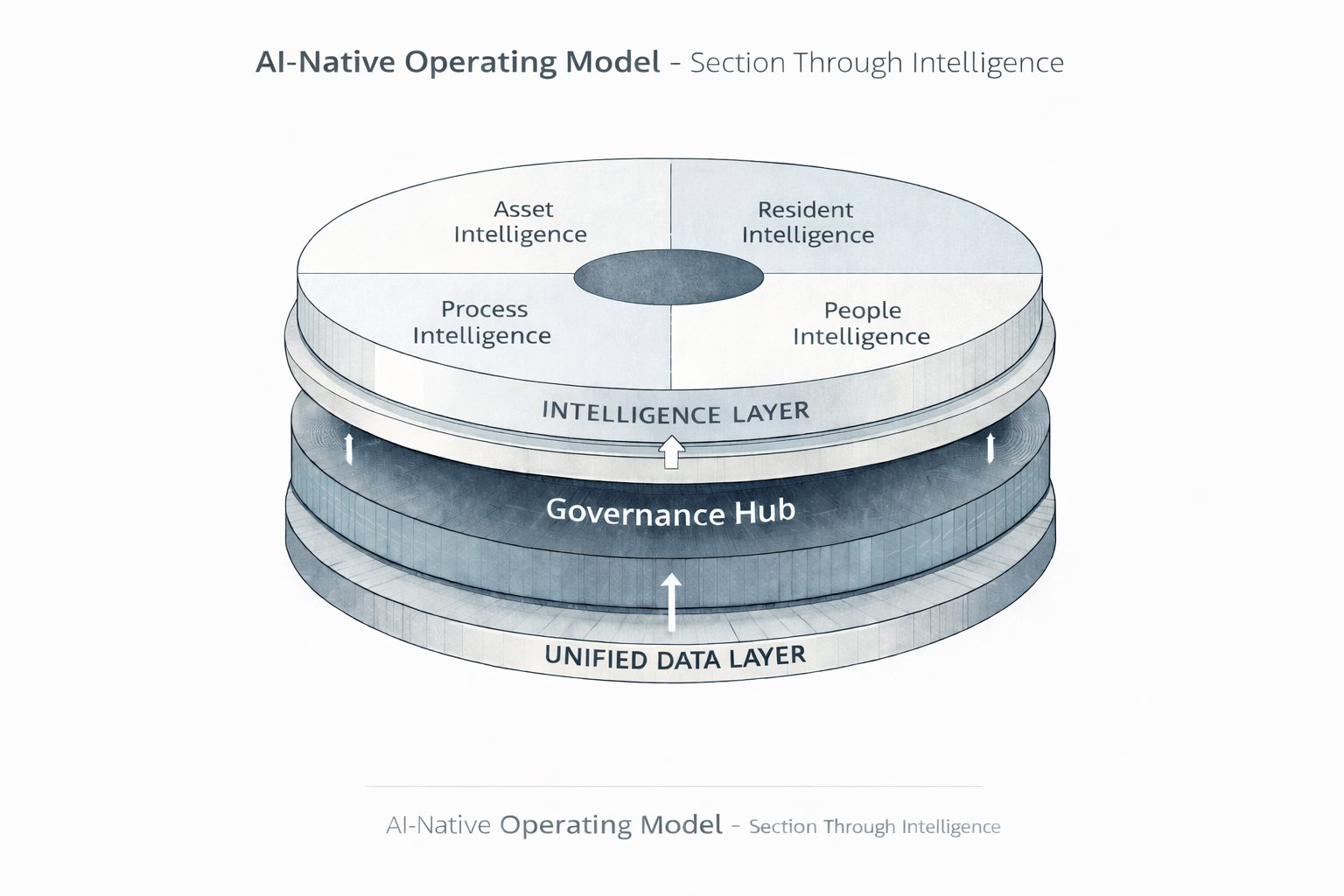
The Governance Intelligence model describes a housing organisation as five areas that continuously monitor and report, sitting on one shared data layer:
- Asset intelligence: the homes and their condition.
- Resident intelligence: the people the organisation serves and their experience of its services.
- People intelligence: staff, structure and the capacity to act.
- Process intelligence: how work actually gets done.
- Boundary intelligence: what crosses between the organisation and its regulators, partners and suppliers.
- A unified data layer underneath, so every part of the organisation reasons from the same facts.
None of these five decides anything. Governance is the sixth domain, and it is categorically different: it holds the conditions under which everything the other five report can be trusted and acted on, and it keeps the decisions that must stay human.
The model is open: download the full specifications
The whole model is published as the AOS Specifications (Adaptive Operating System), freely available to download and use.
- What it is: version 1.0, edition dated 3 November 2026, 64 documents covering the foundation and kernel, each of the five domains, governance intelligence and the board's decision workflows, and acceptance and assurance.
- Who it's for: plain-English guides help boards and senior leaders understand the design. Detailed specifications are written precisely enough for your digital team, your suppliers, or AI coding tools such as Claude Code and Codex to build from.
- How you can use it: the documents are published under the Creative Commons Attribution 4.0 licence. You can use, adapt and share them, including commercially, with credit.
- How boards can use it today: as a benchmark when reviewing your own arrangements; as a reference when specifying requirements for a new system; and as a way to test suppliers, by asking them where their product fits and what evidence they can show.
AOS Specifications v1.0 · 64 documents · free
Guides for people and precise specifications for AI coding agents, published under Creative Commons Attribution 4.0.
For suppliers: where could your product fit? · Licence and attribution
The specifications are a published design, not a certified product. They describe what an AI-native governance architecture should do and how to show that it does, and they are open to challenge. If something looks wrong or would fail in practice, you can say so: a person reviews every contribution. The Architecture of AI-Native Governance (Book 2) explains the thinking behind the design.
Where does your organisation stand?
Most housing associations sit somewhere along the same path. The Governance Intelligence Maturity Tool describes six stages:
- Ad hoc adoption. AI tools are in use here and there, largely on individual initiative, with no shared practice or oversight.
- Piloted experimentation. Use is deliberate and bounded, with pilots and named use cases, but contained rather than embedded.
- Managed deployment. AI is doing real work inside live processes, with basic checks, though governance is still catching up with practice.
- Integrated operations. AI use spans functions with shared standards, training and oversight, but governance of AI is still one function among others.
- Embedded governance. Governance of AI is a recognised domain in its own right: visible to the board, threaded through risk and assurance, not bolted on to IT policy.
- Adaptive, AI-native organisation. Governance is designed to keep adjusting as AI use changes, because it was built around AI from the start rather than retrofitted.
Most published AI maturity models stop at stage 5. Stage 6 is the difference between governance that has caught up with AI and governance designed for it. The AOS Specifications describe what stage 6 looks like in detail.
Where to go next
- To understand the thinking: the Holding the Line series. Book 1, Philosophy and Governance in the Age of AI, asks what governance must become. Book 2, The Architecture of AI-Native Governance, sets out the design. Book 3, The Practice of Governance at Machine Speed, describes what it is like to do it.
- To work from the detail: download the complete AOS Specifications, or browse and search the 64 documents online.
- To learn the vocabulary: Key Concepts, a plain-English glossary of the 13 ideas used in this guide.
- To talk it through: Governance Intelligence works with boards and senior leaders on governance review, AI and governance strategy, and board counsel. Discuss a piece of work.
Frequently asked questions
What is AI governance in a housing association?
AI governance is how a housing association's board decides what AI may do, what must stay with people, and how it gets assurance that those limits are holding. It covers approval of AI systems, the data they use, accountability for their outputs, and how the board itself uses AI-generated information.
Is the board responsible for AI used by suppliers and contractors?
Yes. The board remains accountable for decisions that affect residents and the organisation, whoever supplies the system. Supplier contracts and due diligence should cover how a product's AI works, what data it uses, and how its outputs can be explained and challenged.
Does the Regulator of Social Housing require an AI policy?
No. The regulator has not announced AI-specific rules. It describes its framework as outcomes-based and judges AI by whether landlords still deliver the outcomes in its existing standards. It expects a robust framework and oversight before significant adoption, human judgement in decisions affecting people's homes and lives, and it is clear that responsibility for AI rests with the landlord.
What is the difference between governing AI and governing with AI?
Governing AI is oversight of the tools: policies, risk registers and approval routes. Governing with AI means the board's own information and decision-making change too, so it can see performance and risk as they develop rather than months later.
Which decisions should never be automated in social housing?
Decisions that trade off goods which can't be measured on one scale, such as safety against autonomy or one resident's need against another's, should always come back to a person. AI can show the options clearly, but choosing between them requires someone accountable for the consequences.
What are the stages of AI governance maturity?
The Governance Intelligence Maturity Tool describes six stages: ad hoc adoption, piloted experimentation, managed deployment, integrated operations, embedded governance, and the adaptive, AI-native organisation. Most published models stop at the fifth.
Is there a free framework or specification housing associations can use?
Yes. The AOS Specifications are an open set of 64 documents describing an AI-native governance architecture, free to download and use under the Creative Commons Attribution 4.0 licence. They include plain-English guides for boards and detailed specifications for digital teams, suppliers and AI coding tools.
Where should a board start with AI governance?
Start by finding out where AI is already in use, then agree which decisions must always stay human. The ten questions in this guide work for any system, and the free Maturity Tool gives a two-minute view of where your organisation stands.